
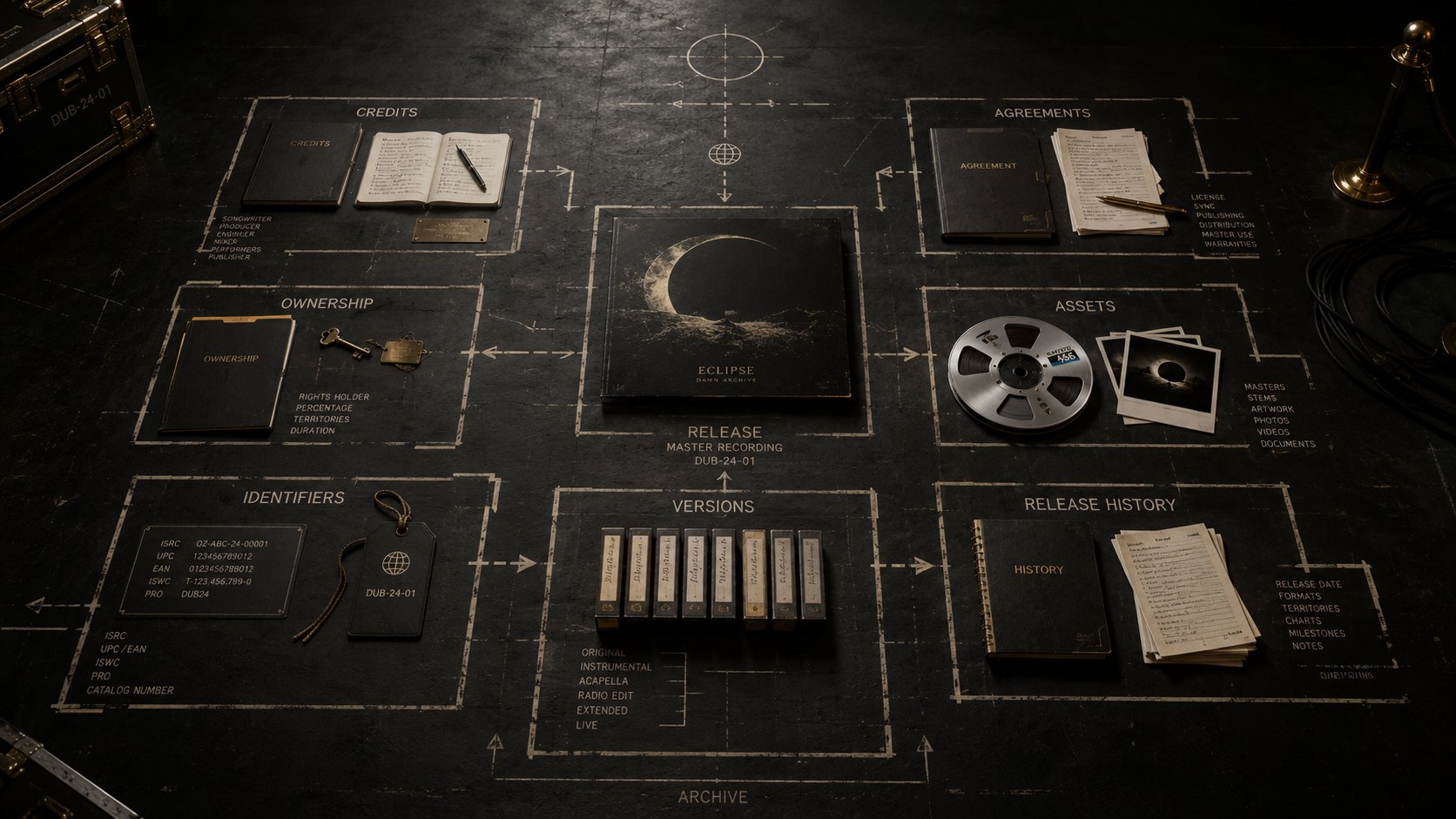
The seven records
01 Credits
Needs ReviewCredits are how a person gets paid and how they get found. A contributor with no role attached is invisible to every system downstream.
Stored: Primary artist · Featured artist · Songwriters · Producers · Engineers · Musicians · Photographers · Designers · Additional contributors
02 Ownership
Conflicts DetectedSplits that do not add up are the most common reason money sits uncollected. Ownership is also the first thing anybody reviewing the catalog asks for.
Stored: Master owner · Composition owners · Publishing shares · Administration · Territories · Ownership percentages · Effective dates
03 Identifiers
Needs ReviewIdentifiers connect the release to platforms, registrations, statements and royalty sources. Incorrect or missing identifiers fragment reporting.
Stored: ISRC · UPC or EAN · ISWC · IPI or CAE · ISNI · Catalog number · Internal release ID
04 Versions
IncompleteEach version is its own recording with its own identifier. A version without a matching asset cannot be delivered, and a version delivered without its own ISRC splits the reporting.
Stored: Original · Clean · Explicit · Instrumental · Acapella · Radio edit · Extended · Live · Remix · Alternate master
05 Agreements
IncompleteAn agreement is what turns a claim into a right. Without the paperwork behind a split, the split is an intention.
Stored: Split sheets · Producer agreements · Featured-artist agreements · Work-for-hire agreements · Master-use licences · Sample clearances · Publishing administration · Distribution agreements
06 Assets
Ready for ConfirmationThe files are the release. Keeping them against the record rather than in a folder somewhere is what makes a re-issue, a sync request or a transfer possible years later.
Stored: Audio masters · Stems · Artwork · Artist photography · Lyrics · Videos · Canvas clips · Campaign files · Press materials · Supporting documents
07 Release History
CompleteCatalog value is a paper trail. What changed, when and on whose authority is the difference between a catalog somebody can buy and one nobody can price.
Stored: Original release · Metadata updates · Artwork changes · New territories · Clean version added · Remix added · Deluxe version · Distribution transfer · Rights corrections · Catalog ownership updates
How one entry moves the others
A songwriter is added under Credits.
- Ownership The composition split has to be reopened and the new share agreed.
- Identifiers Their IPI or CAE number is needed, or the registration cannot name them.
- Agreements The split sheet has to be reissued and signed.
- Versions Every version of the recording inherits the change.
- Release History The correction is recorded, with the date and who made it.
One entry, five consequences. That is why this is a record rather than a form.
What a conflict looks like
From the example passport. Nothing here has been verified — a conflict is open until a person has reviewed it.
Composition shares total 90%
High · OpenOwnership — Three writer shares on file: 40%, 30%, 20%.
Confirm the missing 10% with the writers named in Credits.
Contributor listed without a role
Medium · OpenCredits — Two performers have no role assigned.
Assign a role to each before confirmation.
Version missing a corresponding asset
Medium · OpenVersions — A clean version is listed with no audio file attached.
Attach the clean master or remove the version.
Agreement not signed
High · Awaiting SignatureAgreements — The split sheet has one outstanding signature.
Send for signature before delivery.
How metadata is used
- Who can see it
- You, and the collaborators you invite. A collaborator sees the release they were invited to and nothing else in the catalog.
- How permissions work
- Access is per release and per role. Somebody added to confirm a split does not get the agreements, and somebody sent an agreement does not get the masters.
- What goes to a partner
- Only what a delivery or collection actually requires, and only when you submit it: the release information, the identifiers, the credits and the splits. Documents stay with the record unless a partner needs one for a specific claim.
- How changes are tracked
- Every change is a release-history event with a date and an author. Nothing is overwritten silently, which is what makes the record worth anything in a dispute.
- How documents are handled
- Agreements and supporting files are stored against the release and are not shared outside it without your action.
- Export and removal
- The record is yours: export it, or remove it and the derived findings go with it. The structure is built to be portable rather than to hold you in place.
Portability
The record is built as structured, export-ready release information so it can move: portable metadata design, and an architecture ready for standards work including future DDEX integration. Street Banker is not DDEX-certified today, and nothing here claims otherwise.